
Recommendations for Delhi EV Policy 2026
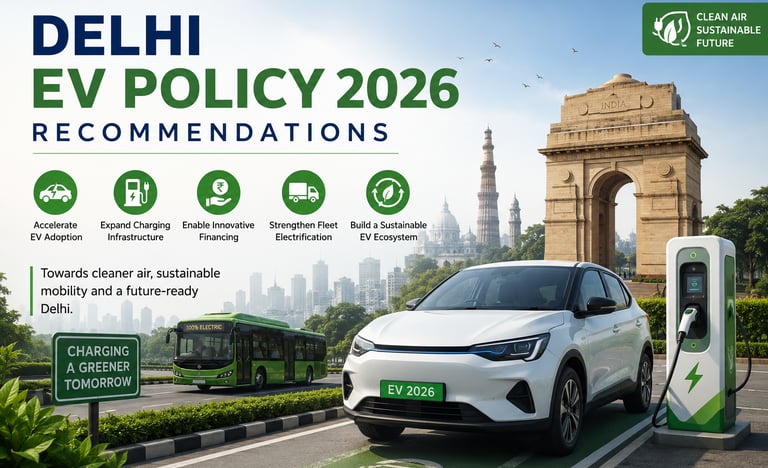
Delhi’s next phase of electric mobility transition requires moving beyond early adoption incentives towards systemic transformation across commercial fleets, public transport, shared mobility, freight movement, and residential communities. With vehicular emissions contributing significantly to Delhi’s air pollution burden, accelerating EV adoption alongside accessible charging infrastructure, innovative financing, and stronger electrification mandates is critical. Recommendations by Bodhaka Advisors focus on strengthening the Delhi EV ecosystem through enhanced incentives, residential and public charging support, improved interoperability and user experience, financing mechanisms for commercial users, and robust implementation frameworks to support cleaner air and sustainable urban mobility.
5/12/20262 min read
A. Background
Delhi has emerged as one of India’s leading electric mobility markets since the launch of the Delhi EV Policy 2020, supported by a combination of targeted demand incentives, regulatory reforms, and progressive charging infrastructure development. The draft Delhi Electric Vehicle Policy 2026–2030 builds on this momentum with a continued focus on accelerating EV adoption, strengthening charging and battery swapping infrastructure, improving air quality, and creating an enabling ecosystem for electric mobility in the National Capital Territory.
The urgency for an enhanced and future-ready EV policy framework is closely linked to Delhi’s ongoing air quality challenge. As highlighted in the draft policy, the Commission for Air Quality Management (CAQM) has identified vehicular emissions as one of the largest contributors to air pollution in Delhi NCR, accounting for nearly 23% of winter pollution levels. Given that two-wheelers constitute nearly 67% of Delhi’s total vehicle stock, alongside the high utilization of three-wheelers, commercial fleets, and goods carriers, rapid electrification of these segments is critical for achieving meaningful reductions in transport-related emissions.
The draft policy appropriately recognises the need for a holistic EV ecosystem by focusing on purchase incentives, charging infrastructure, battery swapping, scrappage incentives, electrification mandates, and institutional coordination mechanisms such as the designation of Delhi Transco Limited (DTL) as the nodal agency and the constitution of a High-Powered Committee for implementation oversight.
However, the EV ecosystem has evolved significantly since the introduction of Delhi’s first EV policy. The sector is now witnessing rapid advancements in charging technologies, battery swapping models, digital payment systems, renewable energy integration, and commercial fleet electrification. Simultaneously, emerging challenges related to financing access, grid readiness, interoperability, end-of-life battery management, urban charging access, and enforcement of fleet transition mandates require stronger policy interventions and institutional coordination. Lessons from leading states further demonstrate that sustained EV adoption depends not only on vehicle subsidies, but also on integrated planning, robust charging density targets, innovative financing mechanisms, residential charging support, and ecosystem-wide stakeholder participation. The next phase of Delhi’s EV transition must therefore move beyond early adoption support towards systemic market transformation that enables large-scale electrification across commercial fleets, shared mobility, freight movement, residential communities, and public transport systems. In this context, the recommendations in the next section seek to strengthen the Delhi EV Policy 2026 by focusing on key priorities.
B. Key Recommendations for the Upcoming EV Policy
Contact:
For digital copies of the report, contact:
Month of Publication:
May, 2026
Disclaimer:
All rights reserved. No part of this publication may be reproduced or transmitted in any form or by any means without permission in writing from Bodhaka Advisors LLP.
Contact
Reach out for tailored climate-specific business advice
info@bodhaka-advisors.com
© 2026. All rights reserved.